Why a “40-Tonne” Feed Bin Does Not Always Hold 40 Tonnes
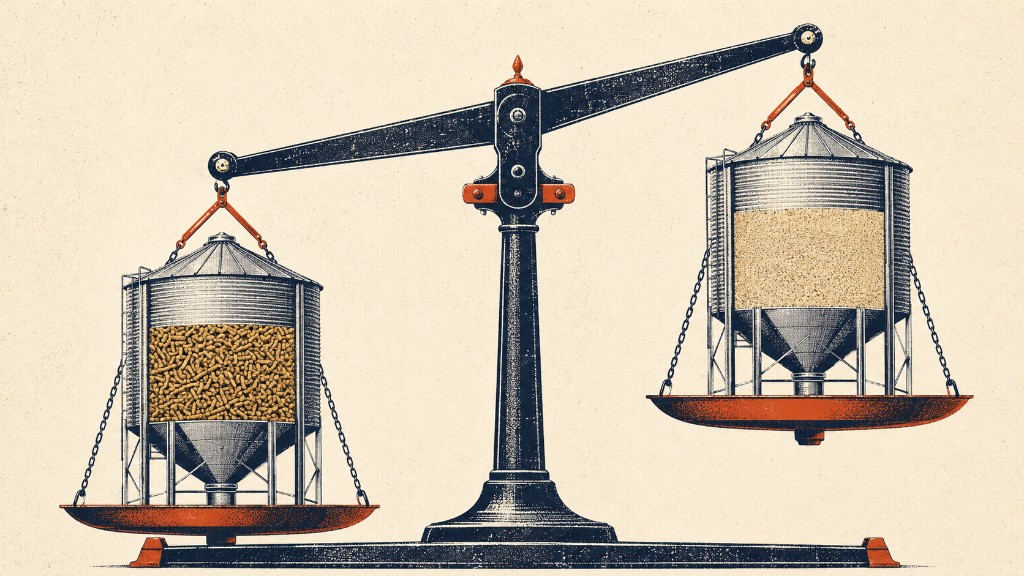
Storage capacity belongs to the bin-and-material combination, not to the bin alone.

Courtesy of BarnX
A bin is often given one capacity: 30 tonnes, 40 tonnes, or 60 tonnes. That number is convenient, but it is incomplete. A bin contains volume. Tonnes appear only after that volume is multiplied by the bulk density of the material inside it.
Change the feed form, particle structure, moisture, or degree of settling, and the same bin can hold a very different mass. This is why a purchasing team can order a “full load” that does not fit, while production believes the bin still has room.
The difference can be much larger than expected
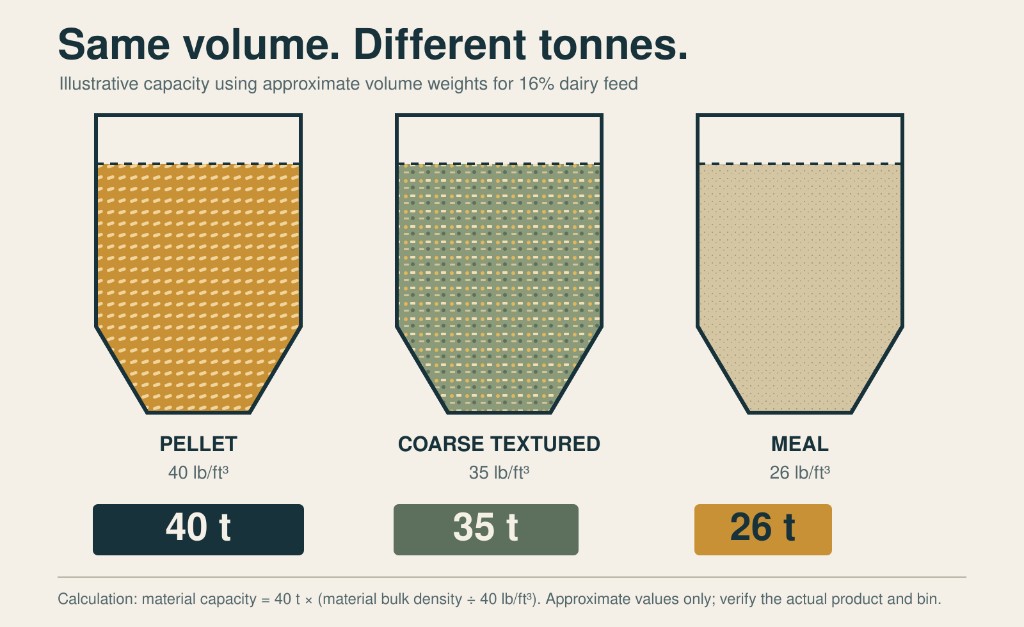
Penn State Extension lists approximate volume weights for three forms of 16% crude-protein dairy feed:
| Feed form | Approximate bulk density |
|---|---|
| Pellet | 40 lb/ft³, about 641 kg/m³ |
| Coarse textured | 35 lb/ft³, about 561 kg/m³ |
| Meal | 26 lb/ft³, about 417 kg/m³ |
Suppose a bin’s usable volume holds 40 tonnes of the pelleted product. Holding the volume constant, coarse textured feed would hold 35 tonnes and meal would hold 26 tonnes.
Courtesy of BarnX
The meal occupies the same space with 14 fewer tonnes than the pellet. That is a 35% reduction from the pellet-based capacity, not a rounding error.
This is an illustrative comparison, not a universal density table. Actual products may differ because formulation, particle size distribution, fat or liquid addition, moisture, handling, and manufacturing conditions all influence bulk density. The correct planning value is the measured value for the actual product and supply stream.
A bin does not have one operational capacity. It has a different capacity for every material placed in it.
Why the number can move after filling
Bulk density describes mass per unit of total occupied volume, including the air spaces between particles. Pellets, coarse particles, flakes, and meal do not create the same void structure. Material can also segregate during conveying and filling, changing the local arrangement inside the bin.
The first loose-density estimate is not necessarily the final answer. Product at the bottom supports the material above it and can compact under that pressure. A University of Kentucky study tested cracked corn, corn meal, soybean meal, cottonseed meal, and dried distillers grain at roughly 8% and 12% moisture under simulated pressure.
In a modelled 1.8 m-diameter by 1.8 m-high bin, packing was approximately 4.3% for cracked corn and 8.1% for dried distillers grain without solubles. In a 5.5 m by 5.5 m bin, the predicted packing factors rose to 6.8% and 13.3%, respectively. Packing also increased as moisture increased.
Those results do not provide a universal correction factor. They show why copying one density from a specification sheet into every bin and season is weak inventory control. Ingredient, moisture, wall friction, bin diameter, and material depth all matter.
Turn capacity into an operating value
Start with the usable geometric volume confirmed by the bin supplier or engineer. Account for the hopper, safe maximum fill level, inlet location, surface profile, and space that cannot be reliably used. Never increase a structural loading limit because a packing calculation suggests more mass might fit.
Then establish a capacity record for each approved bin-and-material combination:
- Record the product, supplier, form, moisture basis, and measured loose bulk density.
- Estimate usable tonnes from safe usable volume × bulk density.
- Apply an operating margin for delivery variability and measurement uncertainty.
- Reconcile the estimate against receiving scale tickets, production withdrawals, and observed high-level events.
- Review the value when formulation, supplier, process, or feed form changes.
The same density change also matters wherever equipment meters by volume. A fixed auger time or volumetric feeder setting does not deliver the same kilograms when bulk density changes.
Capacity should be treated as operational master data, not a label painted on steel.
Continue on the desk
Other briefs worth a read while you are here.
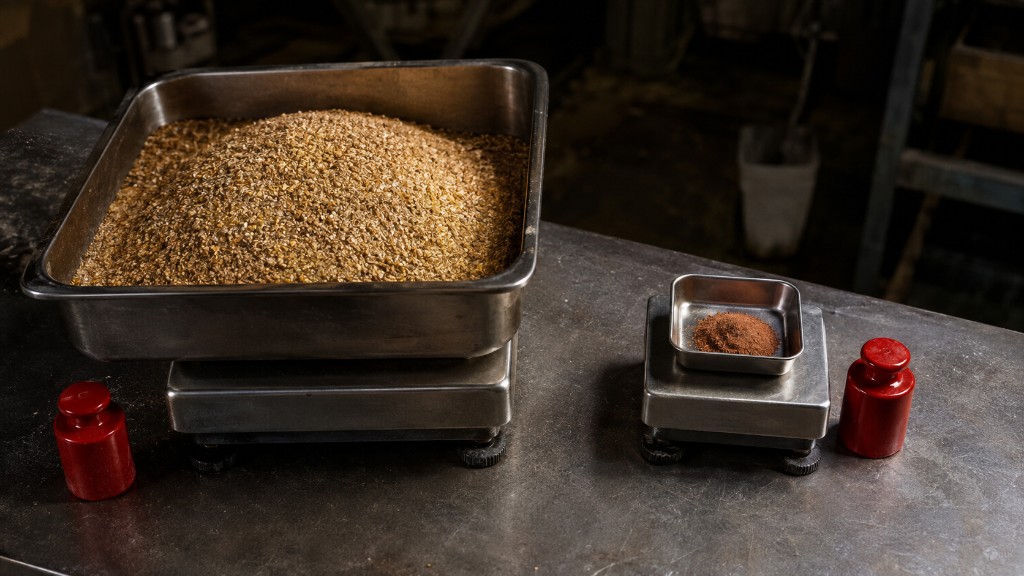 Mill OperationsThe Smaller the Inclusion, the Bigger a Fixed Scale Error BecomesScale accuracy is not one percentage that applies equally to every ingredient. Because relative deviation equals absolute weighing error divided by target weight, the same 1 kg error is 0.1% at 1,000 kg but 10% at 10 kg.
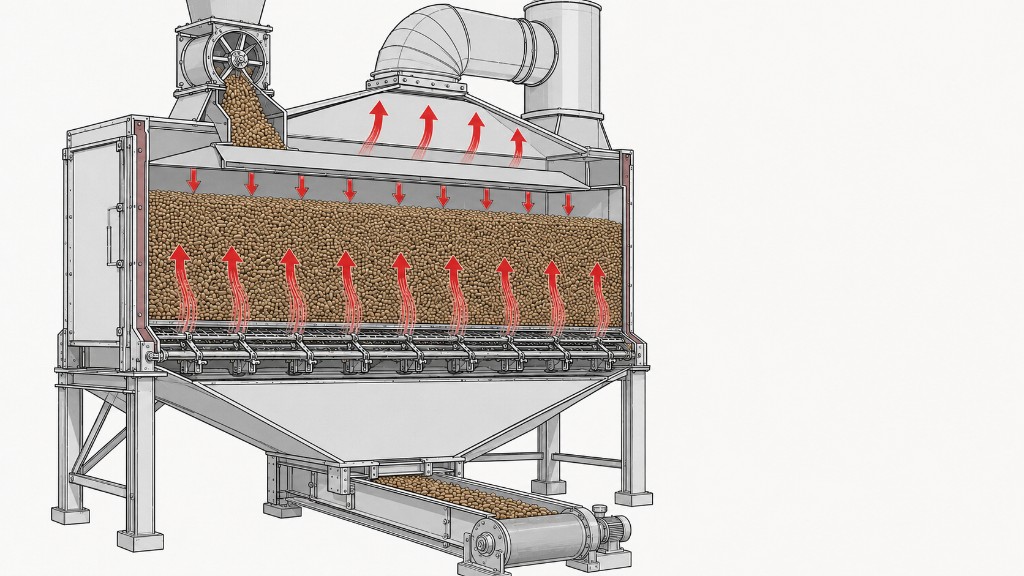 Mill OperationsPellet Cooling Has Two Targets: Temperature and MoistureCooling protects pellet quality and storage stability, but it also removes saleable water. A simple mass balance shows why mills should control outlet moisture and temperature together.
 Mill OperationsOne Rush Order Can Break the SequenceFeed sequencing is more than an efficient way to arrange the production board. When an urgent order changes the run, the mill must reassess the product, species and entire equipment path before the next batch enters the system.